The Camino San Salvador: Four Days of Empty Mountains
Four days from León to Oviedo on the connector route almost nobody walks, and why its emptiness is exactly the point.
I left León at 6:40 in the morning, an hour or so before the sky worked out what color it wanted to be. Pink, then gold, then a soft blue that sat over the mountains in the distance while I walked through empty apartment blocks on the edge of town. Nobody else was awake yet. It felt like I had the whole route to myself, which, on the Camino San Salvador, turns out to be more true than you'd expect.
I found an open bar about two kilometers past the outskirts, and the man behind the counter stamped my pilgrim credential and sent me off with a little speech about the road ahead. Toast with tomato and olive oil, two coffees, a plate of churros I hadn't asked for and ate anyway. That's about as good as a Camino morning gets.
The San Salvador only picks up one real conversation partner in its first stretch: the ground underfoot, which turns from tarmac to open track around La Legua and stays that way for a long, undulating while. It reminded me of Australia. Wide sky, wide space, and flies that seem to materialize only when you're standing in the sun and vanish the second you step into shade. I passed a Spanish pilgrim couple who kept mostly to themselves, with backpacks big enough that I guessed they were continuing on to the Primitivo too. I was right. I saw them again that evening in the albergue in La Robla, and on and off for the next few days.
The climb starts on day two
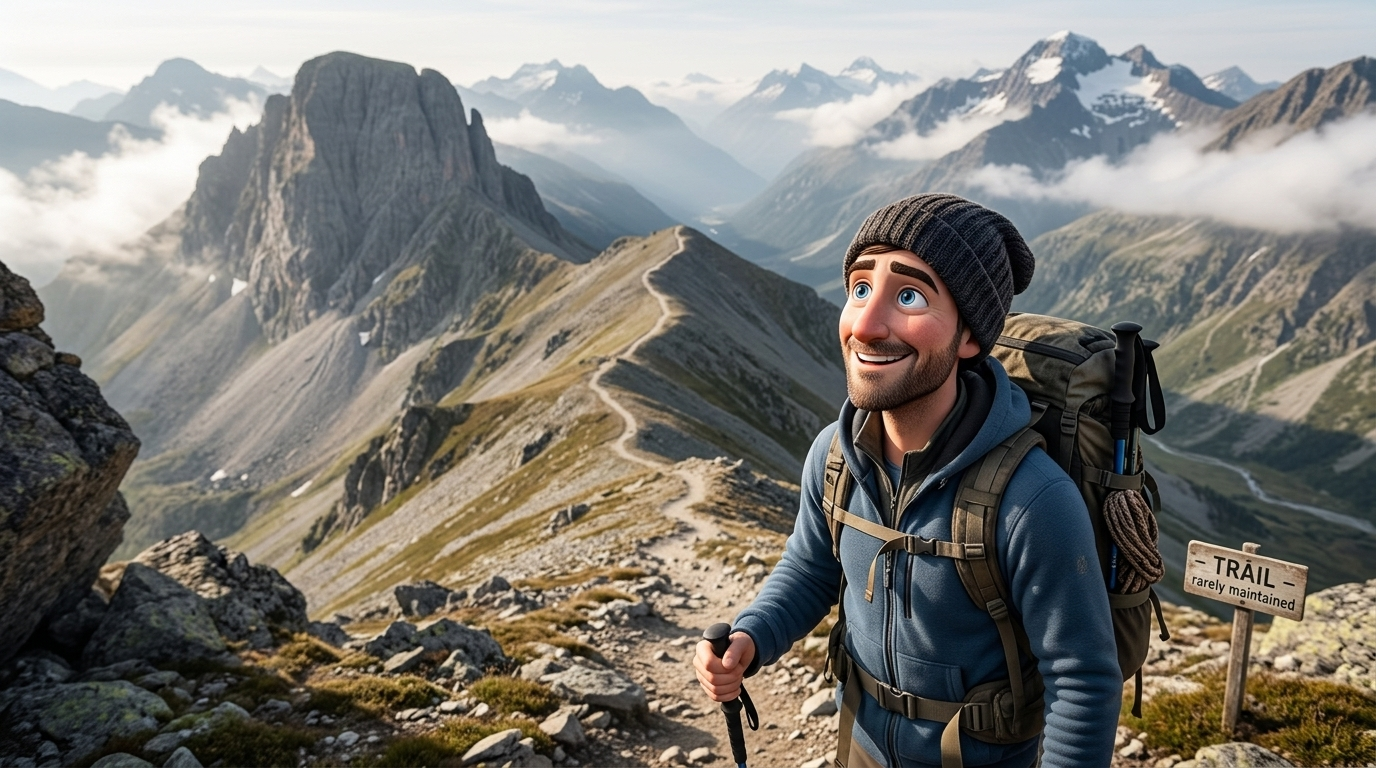
Day two out of La Robla is where the San Salvador stops being a warmup. The road climbs steadily through Peredilla, past a small stone alcove with a statue of the Virgin lit up in a single shaft of sun while everything else around it sat in shadow, then on through La Pola de Gordón and Buiza before the real gradient kicks in: something like 15% straight up into the mountains on a dirt track. It's a slog, but a genuinely beautiful one. Near the top there's a small cross set on a rock, a good place to catch your breath and look back at where you started.
Cross the ridge and the landscape flattens into something that looks less like Spain and more like high moorland, clouds moving in low. I dropped into Poladura de la Tercia that afternoon and paid seven euros for a meat platter that would have cost three times that anywhere else, most of which I saved for the next morning, since the following stage runs almost 30km with barely a coffee in between.
Cows, a sketchy descent, and a mountain crossed in the dark
I left Poladura at 4:45am, well before light, headlamp bobbing in front of me on the climb toward Puerto de Pajares. Warm enough for shorts and a T-shirt even in the pitch black, which surprised me. The descent on the far side turned properly sketchy: tight, loose, and slick enough that I was glad I hadn't tried it at night, with the sky going pink and red behind the ridgeline as I picked my way down. Lower down, the trail cuts through open pasture full of grazing cows and the occasional bull, which is its own kind of route-finding challenge. Nearly 30 kilometers with no open bar the entire way. If you're planning this stage, carry more food than feels reasonable.
That evening, showered and fed in a private room in Campomanes, I finally got a full night's sleep before the final push into Oviedo.
Into Oviedo
The last day is the easiest of the four, mostly on a paved path that follows the river out of Campomanes through Pola de Lena and on toward the coast. It rained lightly overnight, so the whole morning smelled like wet stone and fresh leaves. Oviedo itself caught me off guard. Parts of it feel more Parisian than Spanish, all wide boulevards and grand facades, and by the time I reached the cathedral I'd already passed more pilgrims in an hour than I had in the previous three days combined. That's the San Salvador in one sentence: days of near total solitude that spit you out into one of the busiest junctions on the entire Camino network, the start of the Primitivo.
Closing thought
I don't think the San Salvador is a Camino people walk for the villages or the pilgrim community. There isn't much of either. You walk it for the mountains, the quiet, and the version of yourself that shows up when there's nobody else around to perform for. I've written up the actual day-by-day distances and elevation profiles if you want the numbers behind this. If that sounds like your kind of four days, I built mycaminoguide.com to help plan exactly this kind of route.
Next in this series: Camino Primitivo: Fog, Eucalyptus, and a Vanishing Pilgrim. Or hit subscribe to get the rest as I post it.
Subscribe
New posts on AI, developer relations, photography, and the odd long walk, straight to your inbox. No spam.