The Last Tunnel: Walking Into Santiago on the Primitivo
The final two days of the Camino Primitivo, from the smell of octopus in Melide to a cellist playing in the last tunnel before the cathedral in Santiago.
Melide announces itself before you see it. It's the town where the Primitivo joins the Camino Frances, and it's famous across Spain for one thing: pulpo, octopus boiled and served with paprika and olive oil, sold in nearly every restaurant in town. I crossed into Melide a little after 7am, sky still dark, and even that early the smell was unmistakable.
Joining the Frances at Melide is its own kind of culture shock after more than a week on quieter routes. I'd walked long stretches of the San Salvador and Primitivo without seeing another pilgrim for hours. Past Melide, I hit what I can only describe as a pilgrim superhighway: dozens of walkers all moving in the same direction at once, day packs bouncing, walking poles swinging in every direction like a loosely coordinated hazard. I'd hit peak Frances traffic exactly when everyone was leaving their albergues for the day. Good timing for me, since I'd already covered real distance before most of them had finished breakfast.
I pushed through Arzúa around mid-morning and made the call to keep going another 13 kilometers to Salceda rather than stopping, which set up a shorter final day into Santiago instead of two moderate ones. That's usually how I end up finishing these things: knowing I probably shouldn't push, and pushing anyway.
The last tunnel
I left Salceda at 5:30 the next morning for the final stretch into Santiago. The walk through O Pedrouzo and the eucalyptus forest near the airport felt familiar in a way I couldn't quite place until I remembered I'd walked this exact final section once before, on a different Camino, a different year.
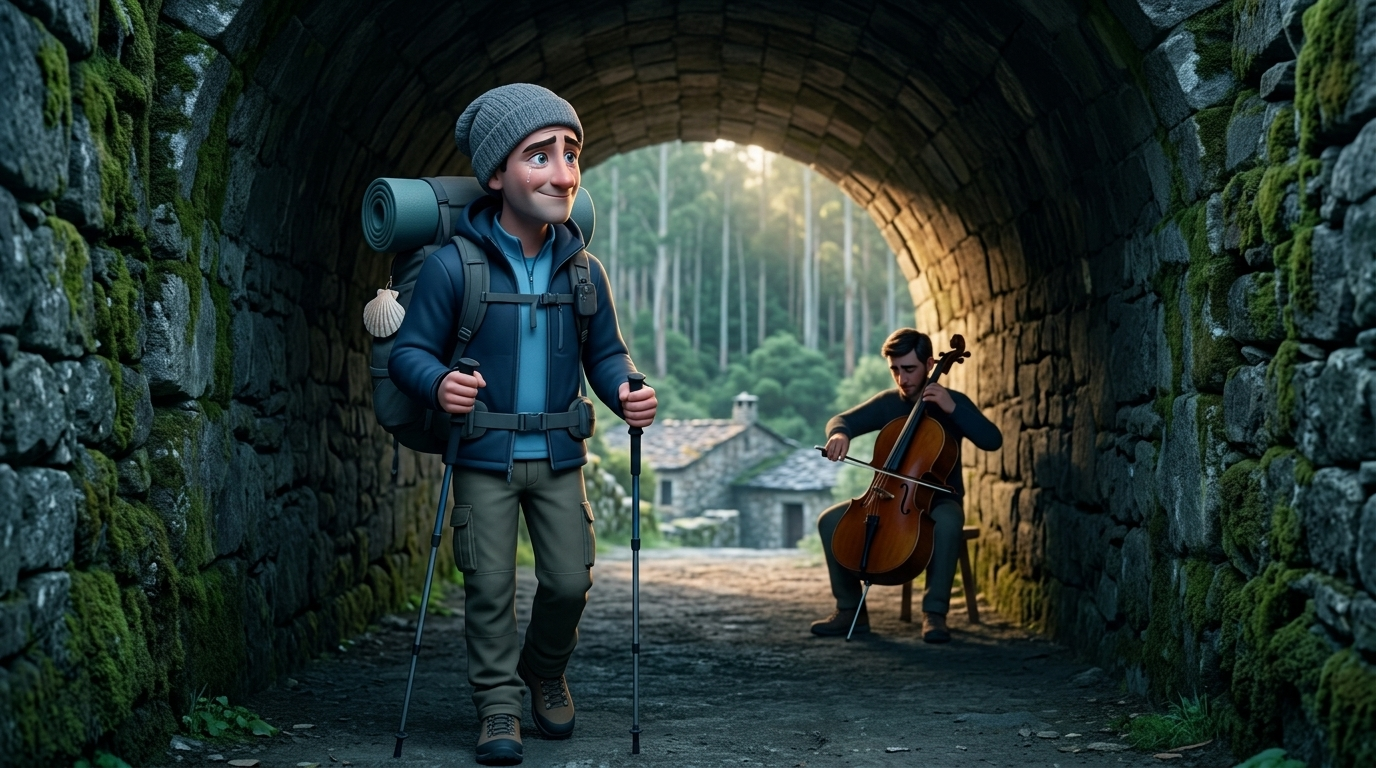
About twelve kilometers out, the trail passes under a long tunnel, and there was a man in there playing a cello. Just one song, unhurried, the notes catching and holding in the concrete the way they only can underground. Eucalyptus trees lined the trail on either side as I came out the far end, sun dappling through the leaves onto the back of my neck, the cello sound fading out behind me the further I walked. I've walked into Santiago more times than I can easily count now, and I'm not sure I've ever felt as at peace doing it as I did in that tunnel and the few minutes after.
Monte de Gozo came next, a small RV park where a handful of camper vans sat parked for the night, and then the outskirts of the city itself. By 10:38am I'd passed the sign marking the city limits. A stop at Burger King, a tradition I've apparently built for myself without ever deciding to, and then the final few blocks to the cathedral.
I sat in the plaza for a long time. It's what I always do at the end of a Camino: find a spot, sit down, and watch everyone else arrive and process it in their own way. Some cry. Some just stand there. Some, like me, mostly just feel tired and a little unsure what to do with their hands now that there's no trail left in front of them.
Closing thought
424 kilometers, two routes most pilgrims never touch, and it ended the way these things always seem to: quietly, with a cello in a tunnel and a plaza full of strangers all arriving at the same ending from completely different directions. If you're plotting your own Camino, mycaminoguide.com is built for exactly that kind of planning.
This is the last of the trail posts. Lugo's Roman walls and the stretch south of them, the leg right before this one, are in Lugo's Roman Walls and the Long Push South. The full breakdown of every stage, distances and elevation included, closes out this series. And if you want more from whatever comes after this, hit subscribe.
Subscribe
New posts on AI, developer relations, photography, and the odd long walk, straight to your inbox. No spam.